Back
Royal Walls
Imposing 16th century fortifications, witness to Ceuta's defensive history.
1 - 1.5 hHistoryPhotographyWalk
Why visit?
A must-visit to understand the strategic character of Ceuta and enjoy a walk among stone, water and harbor views.
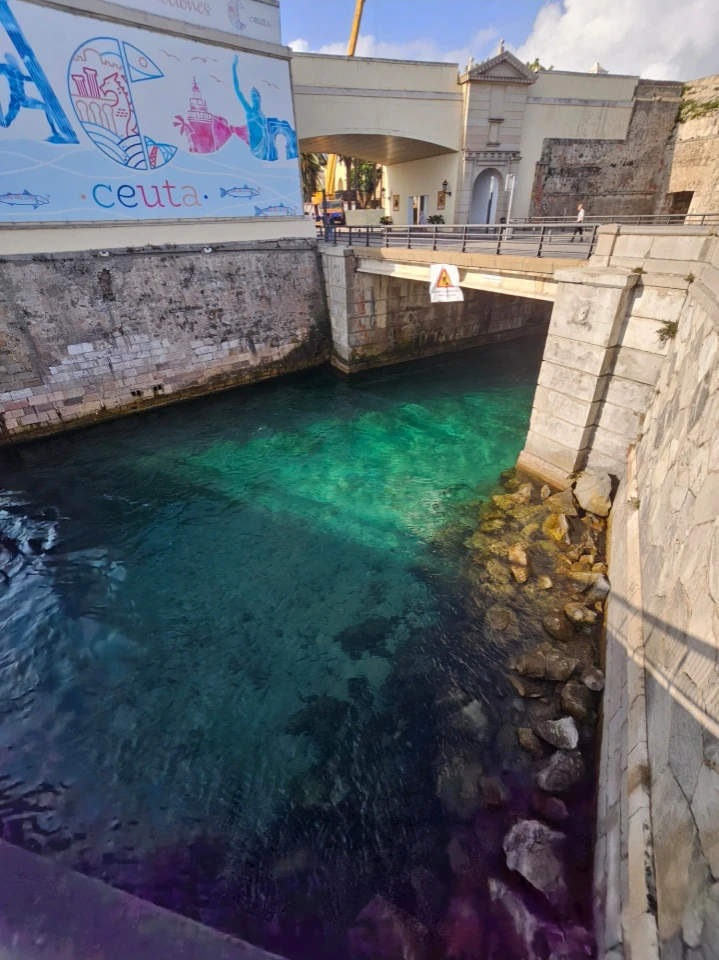
The Royal Walls are one of the most impressive fortified complexes in the Mediterranean. They combine Portuguese and Spanish elements with a navigable moat and bastions that protected the city for centuries.
History and heritage
Ceuta has been a walled city since Antiquity: the Romans built its first defences in the 2nd–3rd centuries, and Emperor Justinian strengthened it in Byzantine times. In 957 the Umayyad caliph Abd al-Rahman III ordered new walls across the isthmus, completed in 962 under al-Hakam II. The great front you see today is Portuguese, built between 1541 and 1549 together with the Bandera and Coraza Alta bastions, reusing earlier remains. Under the Spanish crown, the 18th century added new outer lines, and in 1724 the engineer Jorge Próspero de Verboom designed the fortified barracks that has housed the Parador de La Muralla since 1966. The ensemble was declared a Site of Cultural Interest (BIC) in 1985.
What to see: unique details
- ◆The Royal Moat (Foso Real): a saltwater channel of about 300 metres, navigable by small boats, linking the north and south bays. It is the only navigable moat of Renaissance military architecture in Spain.
- ◆The two bridges over the moat: El Cristo at the northern mouth and Virgen de África at the southern one. A drawbridge once cut the city off from the mainland.
- ◆The Bandera Bastion, a large Renaissance bastion of the first Portuguese line.
- ◆The San Ignacio ravelin in the Plaza de Armas: its gate bears the arms of Philip V and an inscription on the Marquis of Lede's 1720 campaign. Since 1999 it has housed the Fine Arts section of the Ceuta Museum and temporary exhibitions.
Audio guide
~2 min 3 s
You are standing in front of the Royal Walls, the most iconic monument in Ceuta. Look at the water first: that channel, about three hundred metres long, is the Royal Moat, and it links the north bay with the south bay. It is the only navigable moat of Renaissance military architecture in Spain, and small boats can still sail through it. For centuries, when the drawbridge was raised, the old city on the Almina peninsula was cut off from the mainland. Today two bridges cross it: El Cristo to the north and Virgen de África to the south. These stones hold many layers of history. The Romans first walled the city and the Byzantines reinforced it. In the year nine hundred and fifty-seven, the caliph of Córdoba, Abd al-Rahman the Third, ordered new walls across the isthmus, finished five years later. The great front before you was built by the Portuguese between fifteen forty-one and fifteen forty-nine, with bastions such as the Bandera, designed to withstand artillery. Under the Spanish crown, in the eighteenth century, the defences moved outwards with new lines, ravelins and parade grounds. If you enter the Plaza de Armas, look for the San Ignacio ravelin: above its gate you will see the arms of Philip the Fifth and an inscription recalling the Marquis of Lede's campaign of seventeen twenty. Since nineteen ninety-nine, its vaulted halls have housed the Fine Arts section of the Ceuta Museum. Next to the walls, the engineer Jorge Próspero de Verboom designed a large fortified barracks in seventeen twenty-four; today it is the Parador de La Muralla. Since nineteen eighty-five the whole ensemble has been a Site of Cultural Interest. Before moving on, step onto one of the bridges and notice how water, stone and the angles of the bastions fit together: it is the best lesson in why Ceuta was, for centuries, one of the keys to the Strait.
Audio guide played with your device voice (browser speech synthesis).
Practical tips
- •To understand the complex, look at the Royal Moat from one of its two bridges before going in.
- •Low early-morning or sunset light brings out the geometry of the bastions.
- •Expect ramps, stairs and uneven ground: wear comfortable shoes.
- •Check the exhibition opening hours on the City's official website before you go.
- •Combine it with Plaza de África and Paseo del Revellín, a few minutes' walk away.
Not sure what you're looking at?
Snap the building, dish or detail with Discover Lens and I'll explain it.